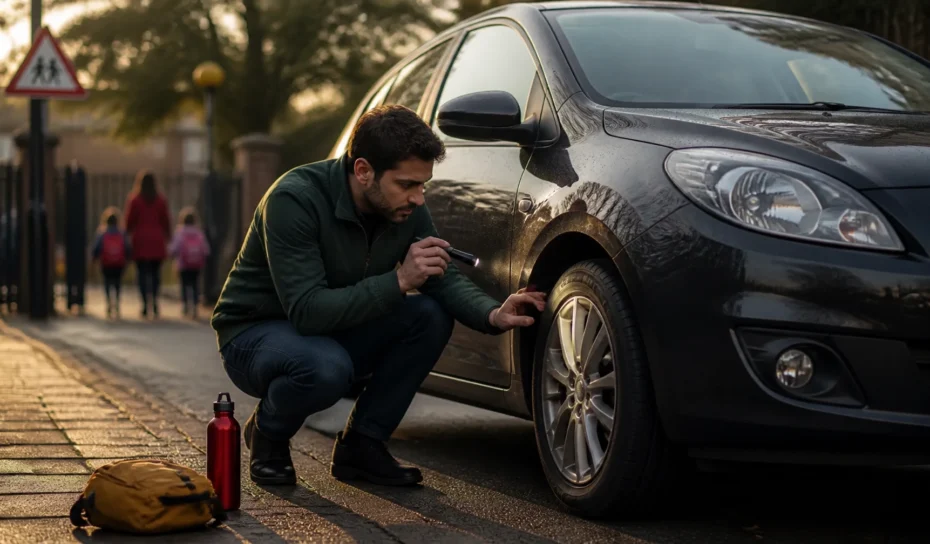
The school gates are about to get busy. From the first week of September, London roads will see more cars, tighter junctions, sudden stops and crowded school car parks.
A worn tyre, weak brake or overdue MOT can quickly become more than an inconvenience. It could leave you stranded, create a serious safety hazard or reduce your stopping ability when a child crosses unexpectedly near the school entrance.
Before the school-run rush begins, use TyreSafe’s simple ACT checks: Air, Condition and Tread. Then complete the wider vehicle checks below. It could help you identify dangerous defects before they become a breakdown or fail an MOT.
Tyre defects caused over 3 million MOT failures in the last 13 months, so this is not a job to leave until the morning of the first school run.
1. CHECK YOUR TYRE TREAD DEPTH
Your tyres are your only contact with the road. If the tread is worn, water cannot clear effectively, increasing the risk of skidding on wet London streets.
The UK legal minimum is 1.6mm of tread across the central three-quarters of the tyre and around its full circumference. However, TyreSafe recommends considering replacement at 3mm to preserve wet-weather grip and braking performance.
You can perform a quick check at home with a 20p coin:
- Insert the coin into the main tread grooves.
- Check several points across the tyre, not just one section.
- If you can see the outer band of the coin, the tread may be at or below the legal limit.
- Check for uneven wear across the centre and edges of the tread.
Uneven wear can indicate incorrect pressure, poor wheel alignment or suspension problems. If the tread is close to 3mm, arrange a professional inspection before the daily school run starts.
At Top German Tyres, you can choose from budget options from £39 fitted, as well as a wide selection of branded tyres. Our budget tyres guide explains how to balance price, quality and family safety.

2. CHECK TYRE PRESSURES WHEN THE TYRES ARE COLD
Tyre pressure changes as you drive. Heat causes the air inside the tyre to expand, which means a reading taken after a journey may not show the true cold pressure.
Check your pressures:
- Before driving, or after the car has been parked for several hours.
- Against the figures in your vehicle handbook or driver’s door frame.
- Including the spare wheel, if your car has one.
- Before carrying extra passengers, luggage or school equipment.
Do not rely on a generic pressure figure. Your vehicle may require different pressures at the front and rear, particularly when fully loaded.
Under-inflated tyres can increase fuel consumption, reduce steering response and make the sidewall work harder. Over-inflation can reduce the contact patch and affect grip. If your car has a TPMS warning, do not simply reset it and continue driving. Find out why the pressure has changed.
A professional check can also identify valve problems, slow leaks and damage that is difficult to see from the outside.
3. EVALUATE PUNCTURES AND SIDEWALL DAMAGE
School car parks are often puncture. Broken kerbs, discarded screws, loose gravel and tight manoeuvres can all damage tyres. A tyre may look acceptable while hiding a nail, slow leak or impact injury.
Inspect each tyre for:
- Nails, screws or other objects in the tread.
- Cuts, cracks or bulges.
- Scrapes caused by kerbs.
- Exposed cords or damaged rubber.
- A sidewall that looks different from the others.
- Repeated pressure loss.
Never drive on a tyre with a bulge or serious sidewall damage. Sidewall damage can compromise the tyre’s internal structure and may lead to sudden failure. A temporary sealant or inflation kit is not a permanent solution for every puncture.
Top German Tyres provides puncture repairs where the damage is suitable for a safe repair, along with replacement tyres when it is not. Our mobile tyre fitting in London can also come to you if a damaged tyre is found at home, work or near the school.
For more practical advice, read our mobile tyre fitting guide.
4. CHECK YOUR BRAKE PADS BEFORE STOP-START TRAFFIC
The school run places heavy demands on your braking system. You may brake repeatedly for crossings, buses, parked cars, traffic lights and congested junctions. That constant heat and friction can accelerate wear.
Pay attention to:
- Squealing, scraping or grinding noises.
- A brake pedal that feels soft or spongy.
- The vehicle pulls to one side when braking.
- Vibrations through the steering wheel.
- A longer stopping distance.
- A brake warning light on the dashboard.
- A burning smell after a short journey.
Worn brake pads can damage the brake discs if ignored. Grinding usually means the friction material has become dangerously thin and metal may be contacting metal.
Do not attempt a rushed DIY fix before taking the children to school. Brake systems require proper inspection, correct parts and safe torque settings. Our team provides brake repairs in London, including brake pad replacement and checks of associated components.
If you have noticed a change in braking, book a free tyre and brake check before returning to the school-run routine.

5. CONFIRM WHEN YOUR MOT IS DUE
An MOT due date that falls in September can easily be forgotten among uniforms, stationery and new school timetables. Check your MOT status now and book ahead if the test is due in the coming weeks.
Driving without a valid MOT can create legal and insurance problems. More importantly, an overdue test may mean you are unaware of faults affecting tyres, brakes, lights, steering or emissions.
Top German Tyres carries out MOT 4/5/7 testing:
- Class 4 for standard cars and small passenger vehicles.
- Class 5 for larger passenger vehicles.
- Class 7 for heavier commercial vehicles.
We recommend leaving time for any necessary work. If your vehicle fails, you may need repairs before it is safe and legal to use for school runs. Our guide to common MOT failures and quick fixes can help you prepare.
If you operate a larger van, read our Class 7 MOT guide before booking.
6. LISTEN FOR CLUTCH AND EXHAUST PROBLEMS
Stop-start driving does not only affect tyres and brakes. It can also expose problems with your clutch and exhaust.
Manual drivers should watch for the following:
- Engine revs rising without a matching increase in speed.
- A clutch biting unusually high.
- Difficulty selecting gears.
- A stiff, juddering or noisy clutch pedal.
- A burning smell after queuing in traffic.
These signs may indicate clutch wear. Continuing to drive can turn a manageable issue into a breakdown at a busy junction. We provide clutch replacement and related inspection services.
Your exhaust also deserves attention. A metallic rattle, louder engine note, visible soot or unusual fumes may indicate a hole, a failed mounting, a damaged silencer or a catalytic converter problem. Exhaust faults can affect emissions and may contribute to an MOT failure.
Arrange a professional car exhaust repair if your vehicle suddenly sounds different. Do not ignore fumes inside the cabin: stop safely, ventilate the vehicle and seek urgent advice.
Our guide to brakes, clutch and exhaust problems in stop-start traffic explains the warning signs in more detail.
7. COMPLETE A LIGHTS, WIPERS AND FLUIDS WALK-AROUND
September mornings can be dark, rainy and difficult to see. Before the first school run, walk around the vehicle and check:
- Headlights, sidelights, brake lights and indicators.
- Number plate lights and rear fog lights.
- Windscreen wipers for splitting, smearing or juddering.
- Windscreen washer fluid level.
- The washer jets, mirrors and windscreen.
- Any warning lights that remain illuminated after starting.
A dirty windscreen or worn wiper can turn glare from headlights into a serious visibility problem. Refill washer fluid with a suitable screenwash rather than plain water, which may not protect the system in colder weather.
Ask another adult to operate the controls while you check the lights. Replace failed bulbs promptly and never begin a wet-weather school run with poor visibility.
MAKE YOUR BACK-TO-SCHOOL CHECK SIMPLE
You do not need to be a mechanic to identify a warning sign. You do need to act before a minor fault becomes a dangerous roadside problem.
Top German Tyres offers the following:
- Tyre fitting from £39.
- New budget and branded tyres.
- A Price Beat Guarantee.
- Professional puncture repairs and general repairs.
- Mobile fitting across London.
- Local pick-up where appropriate.
- MOT testing for Class 4, 5 and 7 vehicles.
- Brake, clutch and exhaust services.
- Opening 7 days a week.
- Special pricing for minicab and fleet drivers.
If you are considering part-worn options, our Used Tyres in Kingsbury provides useful guidance on checking condition, tread and value before you buy.




Post a Comment